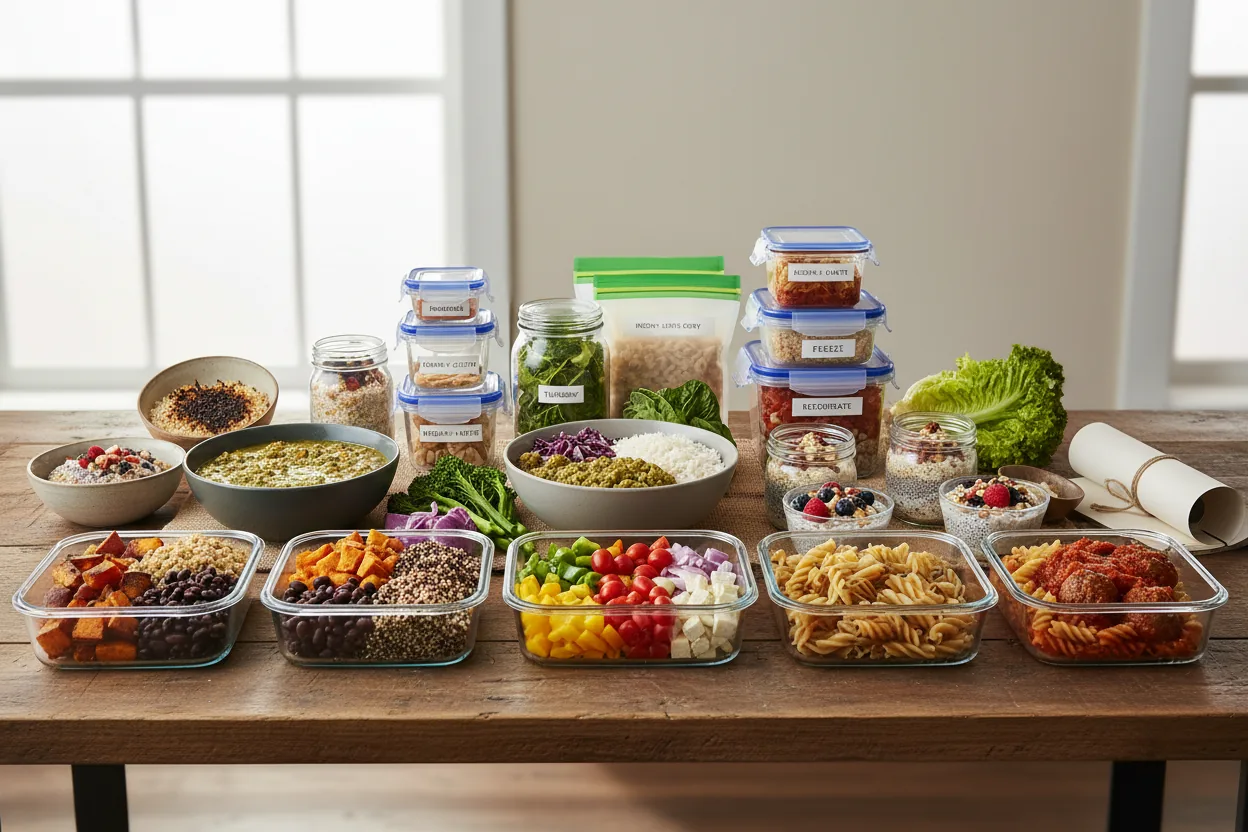
If you've ever opened your fridge on a Wednesday night to three sad containers of plain rice and a wilting bag of spinach, this guide is for you. Vegan meal prep gets a bad reputation because most guides treat it like a math problem — macros, containers, meal counts — instead of what it actually is: a system for making sure future-you always has something good to eat.
We've rebuilt our own meal prep routine around five reusable formulas instead of rigid recipes. Learn the formulas once, and you can rotate ingredients endlessly without ever feeling like you're eating the same meal five days in a row.
Why most vegan meal prep guide advice falls apart by Wednesday
Three things sink a meal prep plan almost every time:
- Everything is cooked the same way. Five containers of roasted vegetables and rice gets old fast, texturally and flavor-wise.
- No sauce strategy. Vegetables and grains need a sauce or dressing to feel like a finished meal, not a homework assignment.
- Storage timelines are ignored. Some prepped components last five days; others are best after two. Treating them the same leads to either waste or, worse, eating something past its prime.
The five-formula system
Instead of prepping five identical meals, prep five components and mix and match them across the week. Each formula below makes roughly 4–5 servings.
1. The grain bowl base
Cook a large batch of a sturdy grain — farro, quinoa, or brown rice hold up best. Toss it warm with a spoonful of oil and a splash of acid (lemon juice or rice vinegar) so it doesn't clump in the fridge.
2. The roasted vegetable tray
Pick two vegetables with similar roast times: sweet potato and broccoli, or cauliflower and chickpeas. Roast at 425°F (220°C) until edges caramelize, about 25–30 minutes. Caramelization is what makes reheated vegetables taste intentional instead of tired.
3. The protein anchor
Choose one: pan-crisped tofu, marinated tempeh, or a big pot of seasoned lentils or chickpeas. This is the component most worth doubling — it freezes well and anchors both bowls and wraps.
4. The sauce that ties it together
A good sauce turns "leftovers" into "dinner." Keep one tahini-lemon sauce and one peanut-lime sauce in rotation; both keep for 5–6 days refrigerated and work on almost anything from the first three formulas.
5. The quick-add freshness layer
Prep this the night before you eat it, not on prep day: sliced cucumber, shredded cabbage, herbs, or a quick pickle. This is what keeps a five-day-old bowl from tasting like a five-day-old bowl.
Reader tip from the comments
"I prep the grains and protein on Sunday but wait to roast vegetables until Tuesday and Thursday, in two smaller batches. Takes 10 extra minutes but the texture is so much better by day four." — Danielle R., verified reader
Storage timelines: what actually lasts
This is the part most vegan recipe blog meal-prep guides skip, and it's the difference between a fridge full of good food and a fridge full of regret.
| Component | Fridge life | Freezer life |
|---|---|---|
| Cooked grains | 5–6 days | 3 months |
| Roasted vegetables | 4 days | Not recommended (texture) |
| Baked/crisped tofu | 4–5 days | 2 months |
| Cooked lentils or chickpeas | 5 days | 3 months |
| Tahini or peanut sauce | 6–7 days | Not recommended |
A sample week, built from the five formulas
- Sunday prep: Farro base, roasted sweet potato + broccoli, crispy tofu, tahini-lemon sauce.
- Monday: Bowl — farro, tofu, sweet potato, tahini sauce, fresh cucumber.
- Tuesday: Wrap — tofu, roasted broccoli, shredded cabbage, tahini sauce in a tortilla.
- Wednesday: Re-roast a fresh vegetable batch (cauliflower + chickpeas), swap in peanut-lime sauce for variety.
- Thursday: Bowl — farro, cauliflower, chickpeas, peanut-lime sauce, fresh herbs.
- Friday: Use remaining protein and grains in a quick stir-fry with whatever fresh vegetable is left.
Our pick for prep containers
Glass containers with vented lids reheat evenly in the microwave and don't stain from turmeric or tomato-based sauces the way plastic does. We use a 5-piece rectangular set for grains and proteins, plus smaller round containers for sauces.
See our kitchen gear picksCommon mistakes that ruin a week of prep
- Prepping the freshness layer too early. Cucumber, cabbage, and herbs wilt fast — prep these in 5 minutes right before eating, not on Sunday.
- Sauce stored in the wrong container. Tahini-based sauces thicken in the fridge; store with an extra tablespoon of water to loosen and stir before using.
- Not labeling freeze dates. "3 months" from the table above only holds if you actually remember when you froze it.
Frequently asked questions
How much vegan meal prep do I need for one person?
Most readers land on 4–5 servings per component, eaten across 4–5 days, with day five often becoming a "clean out the fridge" stir-fry or soup.
Can I meal prep vegan meals without a microwave?
Yes — grain bowls and wraps in this guide are designed to be eaten cold or at room temperature. If you do want something warm, a stovetop reheat with a splash of water takes about 3 minutes.
Is vegan meal prep more expensive than cooking daily?
Generally cheaper — buying grains, legumes, and vegetables in bulk for batch cooking reduces per-meal cost compared to daily shopping trips, and reduces food waste from unused partial ingredients.